MedTech Hiring Decisions, Informed by Search Discipline and Market Context
______________________________________________
Why I Started DukeMed: My Journey from Traditional Recruitment to Search-Led Hiring
I didn’t step into recruitment with a grand vision — I learned through experience.
After graduating from Leeds Beckett University, I started my career in sales "on the road" at Cadbury before moving into a medical device recruitment team in the UK. That role gave me a front-row seat to how competitive and high-stakes hiring in MedTech could be.
A few years later, I relocated to Sydney, where I built and led a medical device recruitment division within a growing executive search firm. Over the next 17 years, I partnered with many of the most recognised MedTech companies, placing commercial, clinical, and leadership talent across the sector.
I worked for many years within contingent recruitment, and it was effective in the right circumstances.
But as MedTech roles became more specialised — and the consequences of a wrong hire more commercial, clinical, and political — the limitations of reactive, vacancy-driven hiring became harder to ignore.
When I stepped away from my previous role, I knew I was done with contingent recruitment as a default model. What I didn’t have was a finished alternative.
DukeMed became the space where a different approach took shape. Over time, the work relied less on speed and volume, and more on search discipline — testing assumptions early, mapping real talent markets, and slowing decisions down before they went live. Not as a rebrand, but as a practical response to what these hiring decisions actually required.
After a 70-day overland journey with family through Australia’s Top End and Gulf — a period of reset and perspective during Covid — ideas for DukeMed took clearer form. Not as a rejection of my recruitment legacy, but as a more deliberate way of supporting MedTech hiring decisions where alignment, timing, and consequence genuinely matter.
How DukeMed Works — And When Search Discipline Matters
MedTech is a specialised, competitive, and rapidly evolving industry.
Hiring the right people isn’t just about filling roles—it’s about aligning expertise with business strategy and ensuring long-term success.
We focus on:
Executive Search & Commercial Hiring
Identifying high-impact leaders and commercial specialists who are rarely active in the open market — and assessing fit beyond CVs alone.
Proactive Talent Mapping & Pipelining
Helping organisations plan ahead through targeted market mapping, early engagement, and realistic visibility — not scrambling once a role becomes urgent.
Market Insight & Hiring Strategy
Using real candidate sentiment, compensation benchmarking, and live market intelligence to inform hiring decisions — not assumptions or recycled data.
DukeMed applies executive search judgement selectively — not exclusively.
While the methodology is derived from executive search, it’s adapted for MedTech hiring decisions at different levels of seniority and risk. That includes leadership appointments, first-in-market commercial hires, and specialist roles where credibility, timing, and market alignment matter more than speed or CV volume.
The goal isn’t to force every hire into an “executive search” box — it’s to apply the right level of rigour to the decision
DukeMed exists to help MedTech leaders make hiring decisions with confidence — whether that leads to a search, insight work, or simply clarity on what to do next.
MedTech disciplines we work across — where search-led hiring matters most
This week in November always takes me back to the early days...
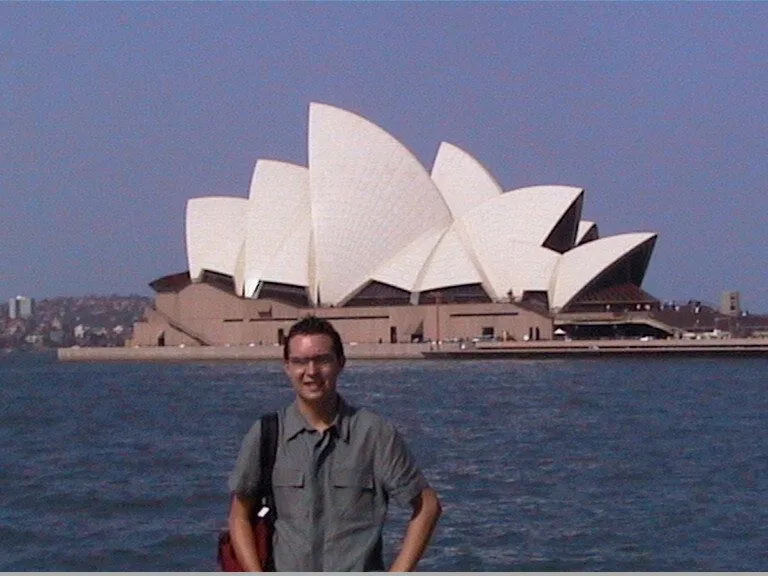
I arrived in Sydney, took the tourist photo at the Opera House 🤳🏻, and started work a few days later — no iPhone 📲, no Google Maps 📍, and no idea where anything was 😩.
I still remember getting lost on the way to a meeting and searching for a payphone. I didn’t meet my boss until the day I turned up. I lived in Bellevue Hill because it sounded close to the 🏖️ beach… and I’m not even a beach person now ( 🚵 )
Back then I thought recruitment was about finding people quickly 💨.
It took a while to realise it’s actually about depth, trust, alignment and helping people make decisions that genuinely change their careers.
Not many photos from that time, but these two sum it up — new country 🇦🇺, new start 🌱, completely unproven.
Still here, still building, still grateful I took the chance (and thankfully no longer dressing like it’s 2002) 🙌🏻.
🎧 I’ve launched the first episode of my employer insight series
This is something 𝓃𝑒𝓌 — and something I’ve been wanting to build properly: a single home for clear, grounded MedTech hiring insight.
The first episode of Inside MedTech Hiring is now live 🚀
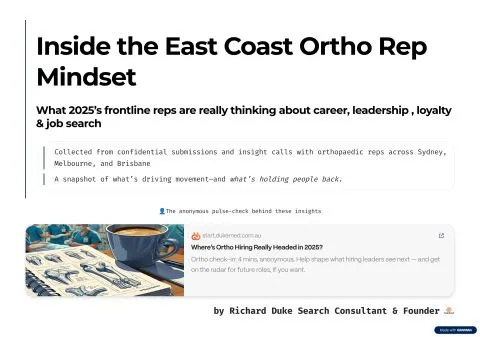
It’s a 15-minute breakdown of what orthopaedic reps quietly (and in some cases, "loudly") told us through the Ortho Moves Index's quiz 📊 and phone-based data collection 📲 — what’s driving movement, what’s holding people back, and how sentiment is shifting heading into 2026.
✨This will be part of a new Substack 💻 that will eventually become the home of my newsletter — where I’ll also share select long-form posts, new audio drops, and deeper insight pieces next year.
You can also listen on Spotify or Apple if that’s easier.
If you give it a listen, feel free to let me know if there’s a particular topic or signal you’d like me to explore in a future episode.
In the past few weeks, I’ve spoken to senior execs who’ve built commercial capability across diagnostics, surgical systems, software, and biopharma.
One conversation in particular stood out — with an operator who’s often been the first commercial hire at early-stage MedTech firms, helping shape the path to scale across the US, ANZ and APAC.
Now? He’s looking ahead — and believes the next big leap is 𝗔𝗜-𝗹𝗲𝗱 𝗵𝗲𝗮𝗹𝘁𝗵𝗰𝗮𝗿𝗲.
He’s not alone ⤵️.
📈 Medtechs are exploring AI in diagnostics, radiology, pathology, and robotic systems — but the commercial blueprint to take these platforms global won’t come from clinical alone.
🤝 Founders will need people who understand both MedTech and what it means to scale.
🇦🇺 And companies like Heidi and Harrison are already showing what’s possible.
It’s just where a few of the most compelling conversations have led lately — and a reminder that great commercial talent doesn’t always look like what you hired last time.
If you’re building something at the ᴀɪ–ᴍᴇᴅᴛᴇᴄʜ ɪɴᴛᴇʀꜱᴇᴄᴛɪᴏɴ 🔀 and want to sense-check what’s possible, I’d be happy to chat.
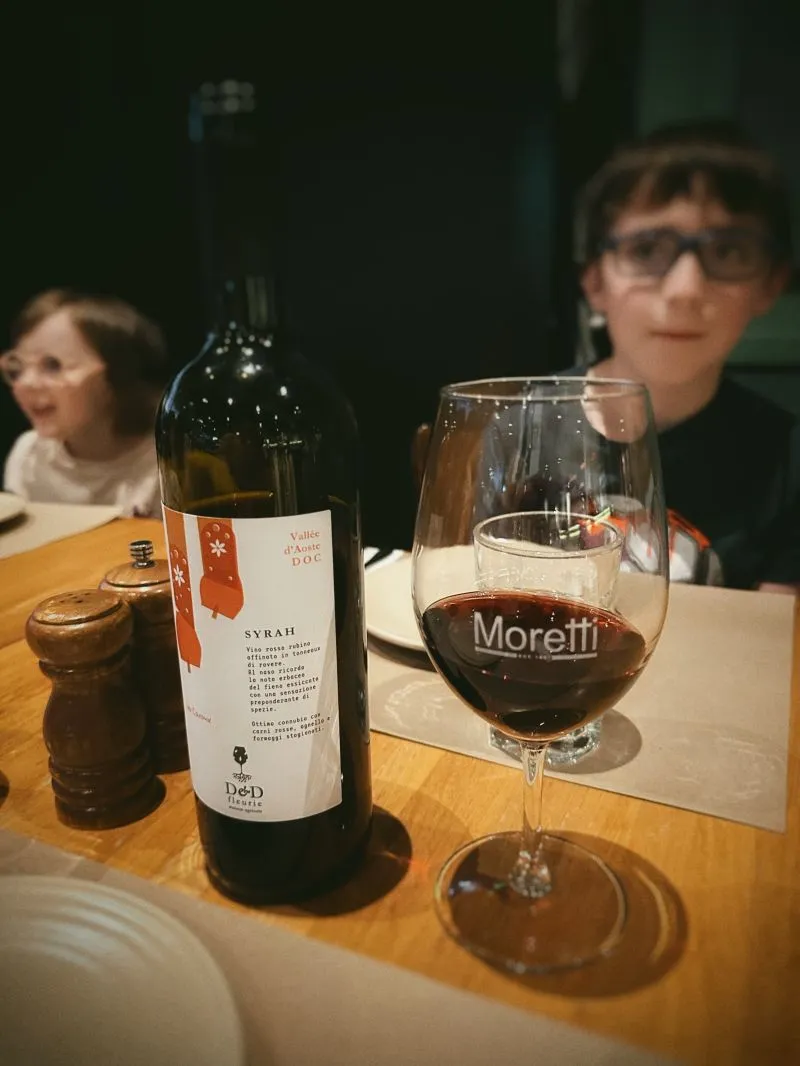
Birthday yesterday, marked with a Tuesday night BYO and family dinner.
The bottle 🍷came all the way back from a hamlet called Vetan in the Aosta Valley🇮🇹⛰️. We liked the little mountain restaurant there so much we went back three times.
The food was very traditional but excellent, and the owner trusted us enough to pay the next day, even keeping opened bottles aside with our names on it, “the bikers.”🤓
Like the wine, I’d like to think I’m maturing with age and grateful the flavour of those memories lasts.
Back on deck this week after a break— Europe is never a quick hop, but worth every kilometre 🤓.
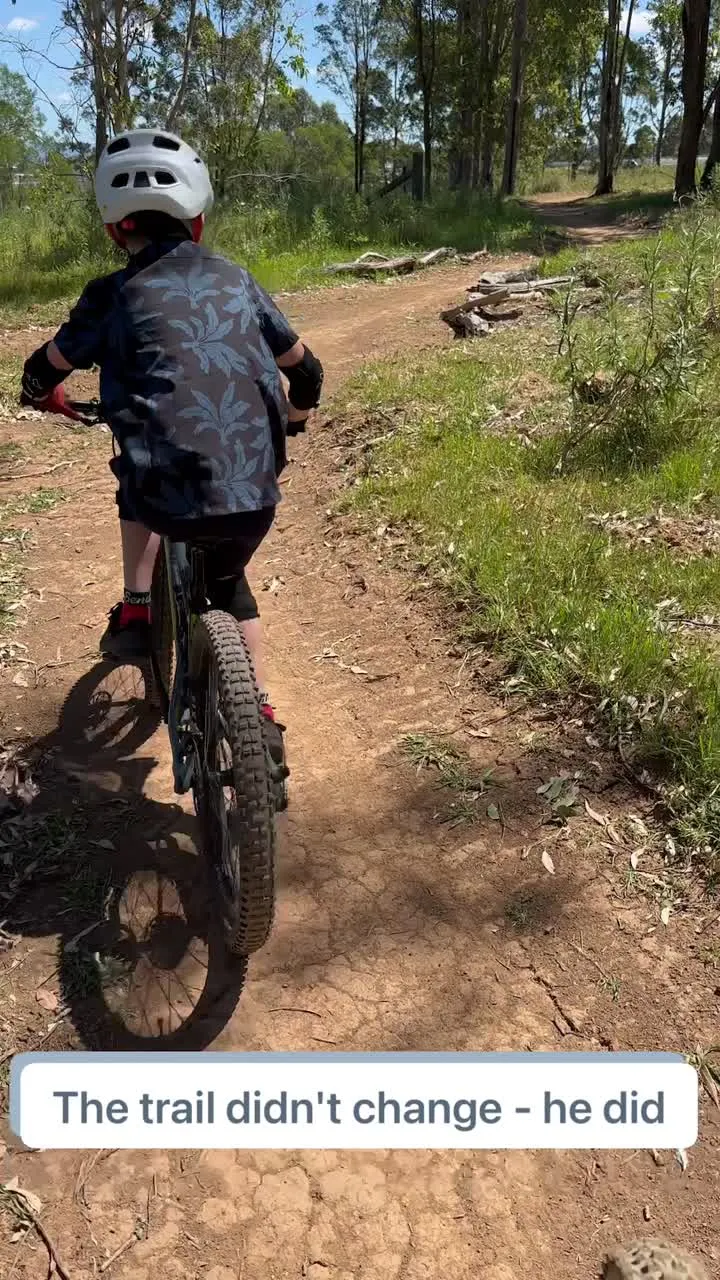
Part family trip 🧑🧑🧒🧒, part challenge 🎯— it included my first ever pairs Enduro race in the French Alps and later some self-guided ridgelines 🚵.
Typically, race solo, so pairing up with a friend was a first.
It was fun, but also full of teething problems: 𝘤𝘰𝘮𝘮𝘶𝘯𝘪𝘤𝘢𝘵𝘪𝘰𝘯, 𝘮𝘪𝘴𝘮𝘢𝘵𝘤𝘩𝘦𝘥 𝘱𝘢𝘤𝘦, 𝘢𝘯𝘥 𝘦𝘷𝘦𝘯 𝘴𝘰𝘮𝘦 𝘮𝘦𝘤𝘩𝘢𝘯𝘪𝘤𝘢𝘭 𝘪𝘴𝘴𝘶𝘦𝘴.
By the last day, we’d found our rhythm, and that made all the difference.
The organiser joked that every year there’s usually at least one rider who gets a helicopter ride off the mountain on day one. Most crashes happen in the first few stages — a reminder of how high the stakes can feel.
For me, though, this wasn’t about being a “serious racer" vs the clock ⏱️ or podium.🏅 What struck me was how different it felt to ride as a team. 👬
You can be strong individually, but if you don’t sync with your teammate, you only get half the result. Once we found our flow, we improved massively 📈.
The best outcomes don’t come from perfection — ⚡️they come from how fast you 𝐚𝐝𝐚𝐩𝐭, 𝐜𝐨𝐦𝐦𝐮𝐧𝐢𝐜𝐚𝐭𝐞, 𝐚𝐧𝐝 𝐫𝐞𝐬𝐞𝐭.
Recharged, and continuing to share what’s next from the Ortho Moves Index 🗣️— exploring what’s really driving reps to move, and what’s keeping them stuck. More on those takeaways soon :-)
Some reps are being tapped on the shoulder constantly. Others? Barely a whisper.
The Ortho Moves Index has started to reveal a few early patterns — based on initial responses from professionals working in orthopaedic sales, marketing, and leadership roles.
One highlight stat: 💬 56% say they’re regularly contacted about job opportunities.
That leaves a large portion who aren’t hearing much at all 🫥.
I’ve pulled together a short blog with a few early signals — and a way for others to add their perspective if they want to: 🔗👇 https://lnkd.in/gWYdZpY6